If you’ve ever spent a Saturday morning wrestling with a compact tractor mower attachment—either scalping a narrow strip of grass along a fence line or leaving the lawn looking like an unkempt patchwork quilt—you know how frustrating a poorly adjusted cutting height can be. As someone who’s spent the last 12 years as a compact tractor supplier, I’ve heard every frustration: “I thought I set it right but the front end’s lower than the back,” “The manual said ‘adjust to desired height’ like that’s helpful,” “I burnt out my belt because I cranked it too tight.” The truth is, adjusting your mower attachment’s cutting height isn’t just a matter of turning a few knobs—it’s a mix of understanding your specific compact tractor’s design, the grass you’re cutting, and small details that even experienced operators miss. Let’s walk through this step by step, with real-world tips I’ve shared with hundreds of customers who’ve turned uneven lawns into the envy of the neighborhood. Compact Tractor

First, let’s get one thing straight: not all mower attachments for compact tractors are the same. When I started in this business, I saw customers buying a generic mower attachment without realizing it’s matched to the wheelbase and lift capacity of their specific tractor. That’s why the first rule of adjusting cutting height is checking the compatibility between your attachment and your tractor before you turn a single bolt. For example, a 60-inch mid-mount mower attachment fits tractors with a 1,200-pound or more lift capacity—if you try putting that on a smaller, 20-horsepower model, the attachment will sag on one side when you lower it, leading to uneven cuts. I tell every new customer: before adjusting anything, confirm your attachment’s model number matches the manual for your tractor. This isn’t red tape—it prevents the kind of misalignment that makes your height adjustment useless from the start.
Next, you need to know what cutting height you’re actually trying to achieve. Most compact tractor mower attachments have a range of 1 to 4 inches, but that range isn’t universal. A 1-inch setting is for freshly overseeded lawns in cool seasons, where you don’t want to damage tender new grass. A 4-inch setting is for drought-stressed lawns, where longer grass retains moisture and resists weeds. Here’s a trick I learned from a farmer customer in Iowa a few years back: hold your hand next to the grass blade when it’s dry. If the grass is as long as the distance from the tip of your index finger to your first knuckle, that’s a good baseline. If it’s longer, crank the height up a notch; if it’s shorter, lower it. This is way more reliable than guessing by the number on the adjustment lever, which can be off by up to half an inch on older attachments.
Now, let’s get hands-on with the adjustment process, step by step. I always do this with the tractor on a flat, level surface—your driveway or a concrete pad in the garage works perfectly. Never adjust cutting height on uneven ground; even a small tilt will throw off your measurements. Start by parking the tractor, turning off the engine, and removing the key. You don’t want the tractor lurching while you’re under the mower. Next, locate your adjustment points. On most mid-mount mower attachments (the most common for compact tractors), there are four adjustment points: two at the front of the mower deck, two at the back. Some rear-mount attachments have adjustment points on each arm that connects the mower to the tractor’s three-point hitch—look for notched pins or bolts that lock the height in place.
Here’s where most people make the big mistake: they adjust only the back of the mower, assuming front height will match. That’s wrong. The front of the mower should always be 1/8 to 1/4 inch lower than the back. Why? Because when you drive the tractor forward, the grass blades bend slightly under the cutting deck. If the front is the same height or higher, you’ll scalp the front edge of the lawn and leave the back longer, creating a “staircase” effect. To get this right, first measure the ground clearance at the front of the mower deck. Use a ruler or a tape measure to get the distance from the bottom of the blade housing (the part that covers the blade, not the tip of the blade) to the ground. Then adjust the front pins or bolts until that measurement is at your desired height—say, 3 inches for a healthy lawn. Then measure the back of the deck. You want that measurement to be 1/8 to 1/4 inch higher, so if the front is 3 inches, the back should be 3 1/8 to 3 1/4 inches. Tighten all the adjustment pins evenly—never crank one side all the way before the other, that will bend the mower deck and cause uneven cuts.
After you make these initial adjustments, it’s time to test. I always advise taking a small, hidden section of your lawn—like along the side of the garage, where it won’t be obvious if something’s off—to do a test mow. Set the tractor to low speed (high speed will make the deck bounce, masking bad adjustment), drive straight, and stop halfway through the test strip. Get off and look at the cut grass. If you see tufts of longer grass in the middle of the strip, your height is too high. If you see white, crushed grass blades (a sign the blade is cutting too short and tearing the grass), it’s too low. If the cut is even, great—but always go back and double-check the measurements after the test. The motion of driving often jostles the adjustment pins, so a quick re-measurement from front to back will fix any small shifts.
There are a few common issues that come up when adjusting cutting height, and I’ve dealt with all of them over the years. One is “deck sag”—when the mower deck tilts to one side, even after you adjusted the height evenly. This almost always happens because the three-point hitch on the compact tractor isn’t level. Most tractors have a tilt adjustment for the upper link on the three-point hitch. If your deck is sagging to the right, adjust that upper link to be slightly longer, and it will pull the deck level. Another issue is blade wear. If your blade is dull or bent, it will cut unevenly no matter what height you set. I recommend replacing mower blades every 50 hours of use, or sharpening them every 25 hours. A bent blade will also throw the measurement off—always check that the blade is straight by spinning it by hand before you adjust the height.
Something I wish more people knew: adjusting cutting height isn’t a one-and-done task. You need to adjust it based on the season, the weather, and how often you mow. In the spring, when grass is growing quickly, you’ll want to set it 1/4 inch higher than in the summer. In hot, dry summer months, bump it up another 1/4 to 1/2 inch to help the lawn retain moisture, avoid stress, and fight off weeds like crabgrass. If you mow every week, you can keep the height consistent, but if you go two weeks between mows, you should never cut more than 1/3 of the grass blade at a time. If your cutting height is set to 3 inches and you skipped a week, don’t lower it to 3 inches—raise it to 3.5 inches, mow, then lower it back to 3 inches next time. That’s a rule I learned from a customer who scalped his entire lawn once because he forgot this simple tip.
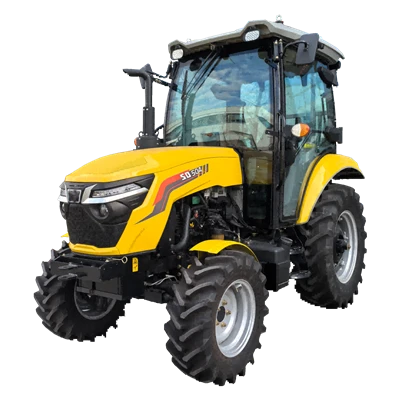
As a compact tractor supplier, my goal isn’t just to sell you a tractor and attachment—it’s to make sure you can use them well. I’ve seen customers spend hundreds of dollars on top-of-the-line mower attachments, only to get frustrated because they didn’t take the time to adjust the cutting height correctly. The steps I’ve outlined here take 20 minutes, tops, and they can turn a mediocre cut into a professional-looking one.
Small Tractor If you’re looking to upgrade your compact tractor or mower attachment, or you have more questions about adjusting cutting height for your specific model, I’m here to help. Every lawn is different, and every compact tractor is built with small quirks that we can tailor adjustments to. Don’t settle for an uneven cut or a frustrating mowing experience—reach out, and we can walk through the details of your setup together.
References
- Compact Tractor Mower Attachment Operation and Maintenance Manual, National Agriculture Equipment Association, 2022.
- Lawn Care Best Practices for Compact Tractor Operators, Turfgrass Management Journal, Vol. 48, No. 3, 2021.
- Three-Point Hitch Alignment for Mid-Mount Mowers, Tractor Supply Technical Guide, 2020.
Sevol International Trade (Shandong) Co., Ltd.
As one of the most professional compact tractor manufacturers and suppliers in China, we’re featured by quality products and good price. Please rest assured to buy advanced compact tractor for sale here from our factory. We also accept customized orders.
Address: 1210, Building 13, No. 13129, Yingqian Street, Liyuan Street, Kuiwen District, Weifang City, Shandong Province
E-mail: Savotrak@163.com
WebSite: https://www.sevol-global.com/
